Swietenia macrophylla · Meliaceae (mahogany family)
Big-leaf mahogany produces one of the most famous timbers in history. Its rich red-brown wood made it so valuable that wild populations were heavily logged.
Quick facts
| Scientific name | Swietenia macrophylla |
| Family | Meliaceae (mahogany family) |
| Native range | Southern Mexico through Central America to the Amazon basin |
| Habitat | Tropical moist and dry forests |
| Typical height | 30–40 m (sometimes over 50 m) |
| Lifespan | Several centuries |
| IUCN status | Vulnerable (VU) |
Overview
Big-leaf mahogany is a tall emergent tree of the American tropics, with a straight trunk and a broad crown. It grows scattered through the forest, often just one or two large trees per hectare.
How to identify it
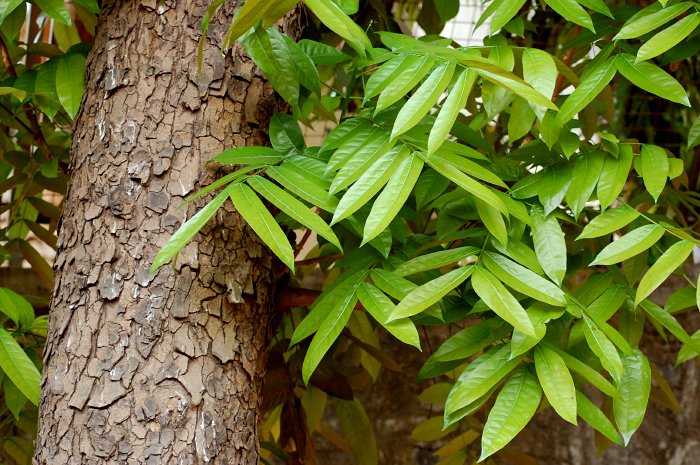
Leaves are pinnate (made of several pairs of shiny leaflets). The fruit is a large, woody, upright capsule that splits open to release winged seeds that spin like helicopters.
Uses and culture
Mahogany wood is stable, easy to carve and polishes to a deep shine, making it a classic choice for furniture, boats and musical instruments such as guitars.
Conservation
Illegal and unsustainable logging has made the species Vulnerable. Since 2003 it has been listed in CITES Appendix II, which means international trade must be legal and sustainable.