Quercus robur · Fagaceae (beech family)
The English or pedunculate oak is a symbol of strength across Europe. A single ancient oak can be home to thousands of other species.
Quick facts
| Scientific name | Quercus robur |
| Family | Fagaceae (beech family) |
| Native range | Most of Europe, east to the Caucasus and Asia Minor |
| Habitat | Lowland broadleaf forests, parkland and hedgerows |
| Typical height | 25–40 m |
| Lifespan | Often 500–1,000+ years |
| IUCN status | Least Concern (LC) |
Overview
English oak is one of the most widespread trees in Europe. Its broad, spreading crown and massive trunk make it a landmark of parks, old forests and village greens. Some ancient oaks in Britain and Scandinavia are thought to be over 1,000 years old.
How to identify it
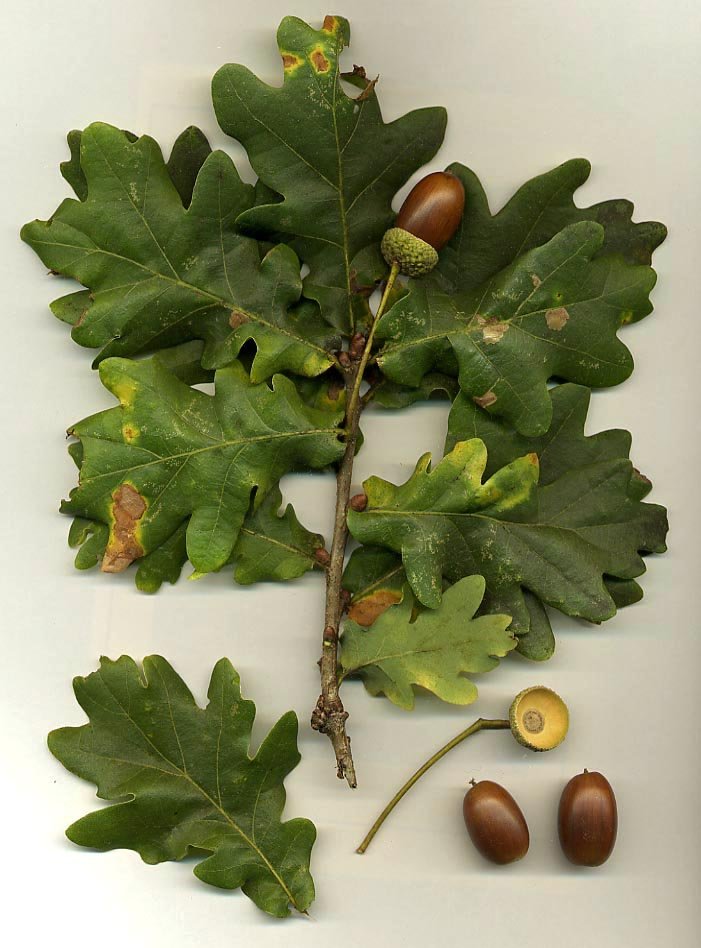
Leaves have rounded lobes and almost no stalk, with two small “ear-lobes” at the base. Acorns hang on long stalks (peduncles) — the origin of the name pedunculate oak. Bark is pale grey and deeply ridged.
Ecology
In Britain alone, over 2,000 species are associated with native oaks, including insects, birds, bats, fungi and lichens. Jays help spread oaks by burying acorns and forgetting some of them.
Uses and culture
Strong, durable oak timber built medieval cathedrals and the wooden warships of the Royal Navy. Today oaks face threats from acute oak decline and the oak processionary moth, though the species remains listed as Least Concern.